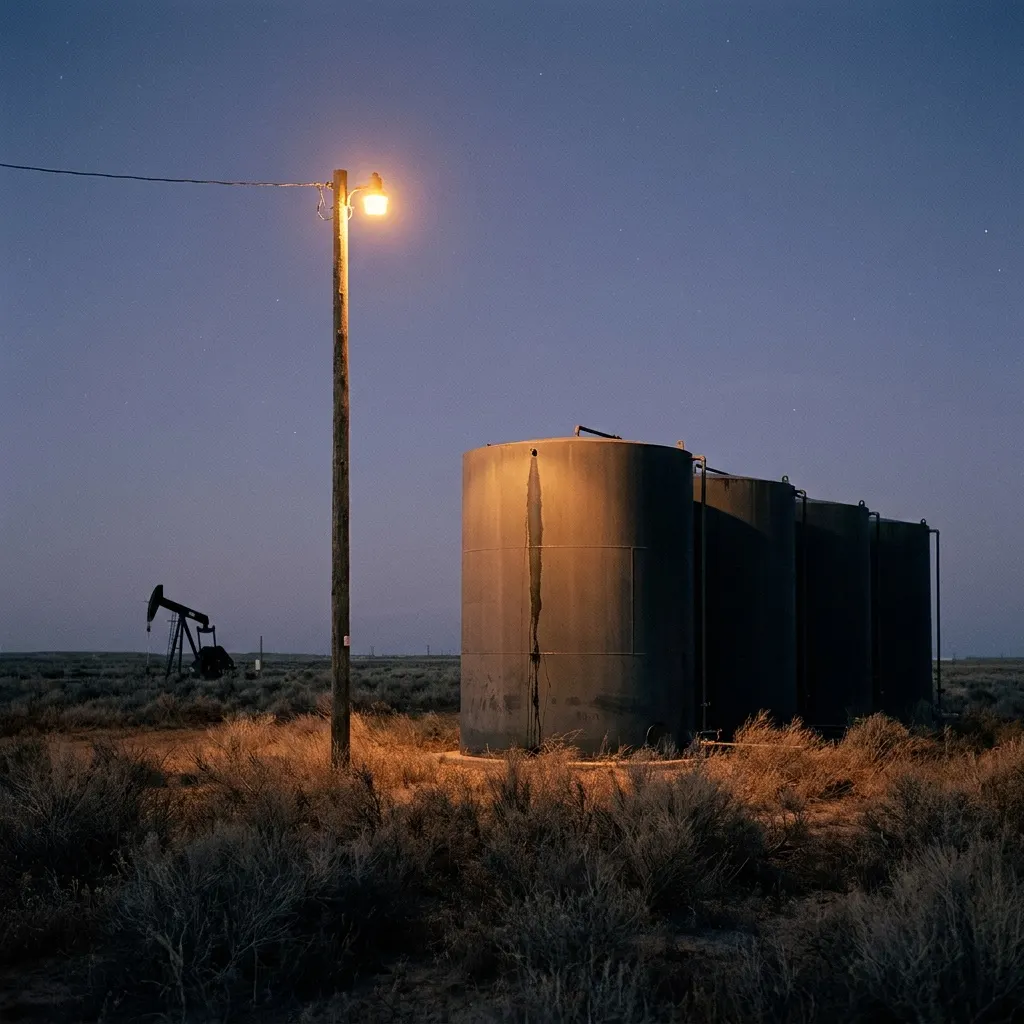
You don’t lose margin all at once.
You lose it when a compressor goes down Friday night and nobody knows until Monday. You lose it when your guy checks the tank at seven in the morning and it goes over at two in the afternoon. You lose it in the gap between visits, which is to say: quietly, invisibly, and on a schedule that always seems to know when nobody’s looking.
I call it the silent bleed. It doesn’t announce itself with alarms or flashing lights. That’s the whole trick. It just eats, hundreds here, a few thousand there, until one day you feel it.
Some context on where I sit: the software my company builds helps manage tens of thousands of wells for independent producers every day, and we talk to hundreds of operators a month. That’s a lot of behind-the-scenes looks at how the best-run outfits actually operate, and a lot of stories about the bleed. Three of them stuck with me.
Three stories, one disease
Different leases, different failures, one disease. Nothing looked wrong. That’s the silent bleed’s signature: everything looks fine right up until the run ticket comes up light.
This is not a pumper problem
Before anybody hears this wrong: this isn’t about lazy pumpers or bad luck.
Do the math on the standard setup. One good hand covering thirty or forty wells scattered across two hundred square miles. Even run perfectly, that route is a surveillance system with a 24-hour refresh rate. Your best pumper sees each lease for a few minutes a day. The other twenty-three-plus hours, every tank, every compressor, every flowline runs on trust, physics, and luck.
The bleed lives in those hours. It isn’t beating your pumper. It’s beating his refresh rate. Friday night to Monday morning isn’t a gap in effort, it’s sixty hours of nobody-could-possibly-know, sitting in the middle of every week, forever.
So why is most of the patch still run this way? Because for years the tools didn’t fit. The remote monitoring the industry offered independents was built like enterprise software and priced like a drilling program: too expensive to justify on conventional wells, too complex to scale across leases, and half the operators who tried it got burned and swore off the whole category. I understand why. When the cure costs more than the disease, you live with the disease.
And so operations that are sharp about everything else fall back on gut feel and hope. Not because anyone chose that. Because until recently, that was the market’s honest offer.
What stopping the bleed actually takes
Not a control room. Not closed-loop automation. Just an answer, at any hour, to the handful of questions the bleed hides behind: what are my tank levels, what are my pressures doing, is that compressor still running, and did anything cross a line I care about since the last time somebody stood there?
That’s the job TinyPumper was built for. A solar-powered gateway the size of a matchbox, cellular and satellite both included so there are no dead zones. Radar on top of the tank, so nothing sits in the fluid to corrode or freeze. Pressure at the wellhead or flowline. A runtime read on the engine or compressor.
The sensors report in every hour, and between reports they check your thresholds every few minutes. The moment something crosses a line, the alert goes straight to your phone. The Friday belt gets caught Friday at 11 p.m., not Monday at 8. The tank that likes to run over gets caught rising, not spilled. And the load that leaves a tank at an hour no truck was scheduled shows up as a number that moved when it shouldn’t have. The bleed’s whole camouflage was the gap. Close the gap and it’s just a list of problems, in time to still be cheap.
Your pumper installs it himself in about ten minutes per site. No trenching, no wiring, no tech visit, no IT guy. One flat monthly rate per location, unlimited sensors, hardware that runs a few hundred bucks a device, one time. And the whole picture lands on one dashboard the entire team can see, phone, tablet, or desktop, so the answer to “did anybody check on that well?” is always yes, about four minutes ago.
The arithmetic of the bleed
Go back to the three stories and run them against a few hundred dollars of hardware.
The thrown belt: one alert, Friday night, and five thousand dollars of deferred production becomes a Saturday-morning belt swap. The saltwater tank: one rising-level alert and a two-thousand-dollar cleanup becomes a closed valve. The missing oil: level drops at hours no truck should be running, visible to three people by breakfast. Any single catch pays for the lease’s whole setup, most of them several times over. That’s not a projection, it’s just the three stories, re-run with the lights on.
The bleed compounds in one direction. Visibility compounds in the other.
If you want to know what it feels like, try it on the lease that worries you most, the saltwater tank with a habit or the compressor that only dies on weekends. Run it for 60 days. If it doesn’t earn its keep, send it back for your money back, and we’ll pay the return shipping. Every sensor carries a lifetime replacement, no fine print. The worst case is you spent two months finally knowing.
If any of this hits close to home, take a look at TinyPumper and take the quiz while you’re there. It takes about a minute, and it’ll tell you straight whether your operation is a fit. The silent part of the bleed ends the day you can see it.